Preserve the Principles. Destroy the Patterns.
In 1942, Joseph Schumpeter gave capitalism its most honest description. He called it creative destruction: progress driven not by stability, but by a continuous process that dismantles outdated industries, technologies, and business models to make room for something better.

History has proven him right. Every great company eventually faces the same choice. Disrupt itself, or be disrupted by someone else.
Over the past year I have written about that choice from several angles. How to navigate when the path isn’t clear. How to read the life cycle of a business and anticipate its inflection points. Why the wellness industry will keep growing while most wellness businesses quietly fail. How category creators feel a shift while it still looks irrational. Where the next great category is forming at the convergence of AI and longevity science.
Different subjects. One pattern underneath all of them.
The companies that endure are the ones willing to destroy their own patterns before the market does it for them. The ones that fail rarely fail suddenly. They drift. They hold on to a model that once worked, long past the point where it still works.
This essay is about the part I left out of every one of those articles.
The same is true of people.
Over-twenty-five-years of building companies across Asia, investing through multiple cycles, and navigating my own seasons of growth and loss, I have come to believe Schumpeter’s insight reaches far beyond economics. Creative destruction is how markets evolve. It is also how leaders mature, how relationships deepen, and how meaningful lives are continually redesigned.
My own definition has become this:
Creative destruction is the deliberate dismantling of obsolete patterns so that our experiences, capabilities, relationships, and resources can be reorganized into something of greater meaning, resilience, and value.
Notice what is being destroyed.
Not our experiences. Not our values. Not our character. Not our history.
Only the patterns that no longer serve us.
That distinction changed how I think about business, investing, leadership, health, relationships, and ultimately the purpose of a well-lived life. It comes down to four moves.
Get clear on where you really are. Preserve the principles. Destroy the patterns. Build the future.
Creative destruction is the discipline. What I call Life Enhancement is the daily practice of it.
The longer I live, the less I believe success is about accumulation. I believe it is about intentional renewal.
I. Get Clear on Where You Really Are – A map is worthless unless you know your current location.

Every meaningful transformation begins in the same place. Reality.
No GPS can calculate a route until it first determines exactly where you are. If the starting point is wrong, every direction that follows is wrong.
Yet most of us spend far more time thinking about where we want to go than honestly assessing where we are.
We dream about a healthier body while avoiding the health check-up. We aspire to financial freedom without measuring our spending. We want stronger relationships without asking the difficult questions. We talk about purpose while living calendars that reflect entirely different priorities.
We chase clarity about the future while avoiding clarity about the present.
When I wrote about muddy waters, I was describing external uncertainty: markets you cannot read, conditions you cannot control, a path you cannot see. My conclusion then was that clarity is not the absence of mud. Clarity is the courage to keep moving through it.
The harder version of that lesson is internal.
Muddy water rarely changes our direction. It obscures our perspective. And the greatest danger has never been uncertainty. The greatest danger is making irreversible decisions from a distorted view of reality.
I have come to believe emotional clarity matters more than certainty. Certainty is a luxury that rarely arrives before meaningful decisions must be made. Emotional clarity comes from knowing who you are, what you value, and who you are becoming, even when the path ahead stays dark.
That kind of clarity requires brutal honesty. About our health, our relationships, our leadership, and our ambitions.
This is why the idea of the quantified self has influenced my thinking so much. Not because a life can be reduced to numbers, but because measurement removes illusion.
You cannot improve a business you refuse to understand. You cannot improve a relationship you refuse to examine. And you cannot intentionally redesign a life you refuse to see as it truly is.
Measurement is not judgment. It is awareness.
I have written that in business, growth does not mean health. Strong demand lets weak models survive far longer than they should. The same illusion operates in life. A rising income, an expanding title, a full calendar. All of it can look like progress while something underneath is quietly eroding.
Looking back, every major transition in my life began long before I made a difficult decision. It began the moment I stopped asking, What do I want? and started asking, Where am I really?
Creative destruction does not begin by tearing down the old. It begins by seeing it clearly.
Key takeaways
- Reality is the foundation of every meaningful transformation. A map is worthless unless you know your current location.
- Clarity is not certainty. It is the emotional honesty to see yourself and your circumstances as they truly are.
- Growth is not the same as health. Strong momentum can hide a weak model, in a business or in a life.
II. Preserve the Principles. Destroy the Old Patterns. – The discipline of intentional evolution.

Once we see reality clearly, the next question is inevitable.
What deserves to be carried forward, and what deserves to be left behind?
Most people assume growth comes from adding. More knowledge, more resources, more opportunities. For years I believed the same. Entrepreneurs are builders by nature. Our instinct is to solve problems by creating, expanding, and accumulating.
Over time I noticed something. Some of the greatest breakthroughs in business, and in my own life, came not from addition but from subtraction.
One of the principles I admire most in engineering is first-principles thinking. Before adding complexity, the best engineers ask a different question. What can be removed? Every unnecessary component eliminated makes the system simpler, stronger, and more reliable.
Life deserves the same discipline. Because most of the obstacles that limit us are not external. They are patterns we continue to carry long after they have served their purpose.
A leadership style that no longer inspires. A business model that no longer creates value. An ambition borrowed from someone else’s definition of success. A habit that once protected us but now keeps us small. An identity we keep defending because we have invested so much of ourselves in it.
The challenge is that not everything deserves to be destroyed. Every significant chapter of life leaves us with two things.
Principles. And patterns.
Principles are enduring truths earned through experience. Integrity. Curiosity. Service. Discipline. Long-term thinking. Love. Character. They are the compass.
Patterns are the methods through which those principles were expressed at a particular moment in time. A business model. A leadership style. A routine. A definition of success. An identity.
Patterns are not mistakes. They are successful adaptations to a previous reality. The tragedy is not that they existed. The tragedy is continuing to rely on them after reality has changed.
The mistake we make is preserving both. We confuse the pattern with the principle, and grow attached to the way we have always done things, believing that changing the method somehow betrays the value behind it.
But principles are timeless. Patterns are temporary. Wisdom is knowing the difference.
The hardest patterns to destroy are almost always the ones that made us successful. Success creates confidence. Confidence becomes certainty. Certainty becomes attachment. And attachment quietly becomes resistance to change.
I described this in business terms when I wrote about the wellness industry. Companies rarely fail because the market disappeared. They fail because they refuse to evolve, running playbooks written for a different era in a fundamentally different world. The real risk was never failure. It was holding on to an outdated model too long.
Writing that, I was describing companies. I was also describing a version of myself.
When I sold the fitness and medical businesses I had spent twelve years building in Vietnam, every logical part of me knew it was the right decision. I had extraordinary mentors who gave me the roadmap for building and exiting in developing markets.
I looked like a genius at the time. The truth is, I stood on the shoulders of mentors who knew the road ahead, which helped me get the timing right. The leadership team I put together also worked very hard, and we built a culture and a company that still creates value after 20 years of operating.
What I was not prepared for was the emotional impact of that first major act of creative destruction.
Intellectually, it was a success. Emotionally, it was a loss.
I had not sold a company. I had dismantled an identity.
The transaction took months. The reconstruction took years.
Only later did I understand that the company was never what I was grieving. I was grieving the patterns through which I had come to define myself. Leadership. Building. Service. Impact. Contribution. None of those disappeared in the sale. They simply needed a new expression, and I had confused the expression with the thing itself.
Perhaps this is why real transformation feels so uncomfortable. Our brains did not evolve to seek uncertainty. They evolved to avoid danger, and for most of human history familiarity increased the odds of survival. Today that same instinct keeps us attached to businesses, relationships, and beliefs that no longer align with who we are becoming.
We mistake familiarity for safety.
People often say experience creates wisdom. I don’t believe that’s true. If it were, age alone would make us wise.
Wisdom is created through reflection.
Every difficult experience leaves us with a choice. We can become bitter, or we can become wiser. The difference isn’t the pain. It’s the meaning we choose to give it. Pain without meaning becomes resentment. Pain connected to a compelling future becomes wisdom.
That wisdom eventually crystallizes into principles. Principles are what remain after emotion subsides, perspective returns, and critical thinking replaces reaction. They are not inherited. They are earned.
Which leads to the distinction I now try to live by.
Stay deeply committed to your principles. Stay lightly attached to the specific patterns through which those principles are expressed.
Hold strong convictions, loosely held.
New information is not an attack on identity. It is an opportunity to improve understanding. Changing our mind is not weakness. It is evidence that truth matters more than ego.
Wisdom is knowing what should never change. Courage is changing everything else.
Key takeaways
- Growth often begins with subtraction rather than addition.
- Patterns are successful adaptations to a previous reality. The tragedy is relying on them after reality has changed.
- The patterns that once made us successful are the hardest, and the most important, to put on trial.
III. Build the Future – Creating a life of intention.

Once we know where we are, preserve what matters, and release what no longer serves us, we reach the most important question of all.
What is worth building?
For much of my life I assumed building was the hard part. Companies. Wealth. Teams. Legacy.
Experience taught me otherwise. The hard part is not building. The hard part is knowing what is worth building.
That question cannot be answered by the market. It cannot be answered by society. It cannot be answered by comparison. It can only be answered by understanding yourself.
The ancient Greeks carved two words into the Temple of Apollo at Delphi.
Know Thyself.
If we don’t understand our values, we inherit someone else’s. If we don’t define success intentionally, culture defines it for us. If we don’t consciously choose our future, we slowly drift into one.
Drifting is the default. Intention is a choice.
But self-awareness is not the destination. It is the foundation upon which intentional lives are built.
A meaningful life is rarely discovered. It is built. Not through dramatic moments, but through consistent, directed action. Every conversation. Every investment. Every relationship. Every decision. Each one either moves us toward the person we intend to become, or quietly reinforces the person we used to be.
This is why I have become interested in the idea of a reverse bucket list.
Instead of asking, What do I still want to accomplish? I ask, What ambitions would I willingly let go of if I knew I could still live a deeply meaningful life?
The exercise is not about reducing ambition. It is about refining it. As principles become clearer, ambitions naturally change. Some belonged to youth. Some belonged to ego. Some belonged to other people’s expectations. Some were worth pursuing. Others were simply inherited.
Perhaps the highest form of intelligence is not getting everything we want. Perhaps it is learning what is truly worth wanting.
When I wrote about category creators, I made the point that people do not join movements because of features. They join because the movement reflects who they are becoming.
The same thing is true of a life.
You are the first member of whatever you are building. The strongest organizations, families, and communities do not simply accept us as we are. They remind us of the principles we have chosen. They reinforce the future we have committed ourselves to building. They don’t remove the human experience. They help us make meaning from it.
Real transformation is deeply personal. Lasting transformation is profoundly communal.
That is also why growth alone is incomplete.
Growth creates happiness because it reminds us we are becoming capable of more. But eventually growth seeks expression, and that expression is contribution. Contribution transforms personal success into shared significance, and creates fulfillment.
First we grow. Then we contribute.
Key takeaways
- The greatest challenge is not building a life. It is knowing what is worth building.
- Self-awareness is not the destination. It is the foundation intentional lives are built upon.
- Growth creates happiness. Contribution creates fulfillment. A meaningful life requires both.
IV. Life Enhancement – Living a life of intentional evolution.
Every philosophy eventually faces the same test. Can it be lived?
Ideas are only valuable if they change how we act. And the quality of our lives is determined less by the goals we set than by the systems we repeatedly practice.
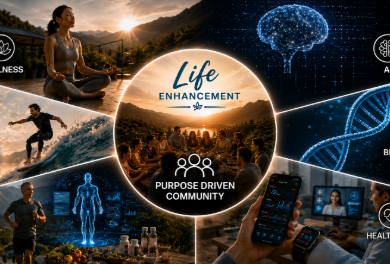
I named Life Enhancement fifteen years ago on a stage in Lake Tahoe, and I have spent the years since describing it as a category: the convergence of AI, longevity science, community, and embodied experience into systems that make people measurably more alive.
That is still what I believe about the market. It is not the whole of what I believe about the idea.
Life Enhancement is the intentional practice of continually evolving into the person the future requires you to become, while remaining deeply rooted in the principles that define who you are.
Not once. Repeatedly.
The goal is no longer to survive change. It is to thrive because of it.
And a practice needs instrumentation.
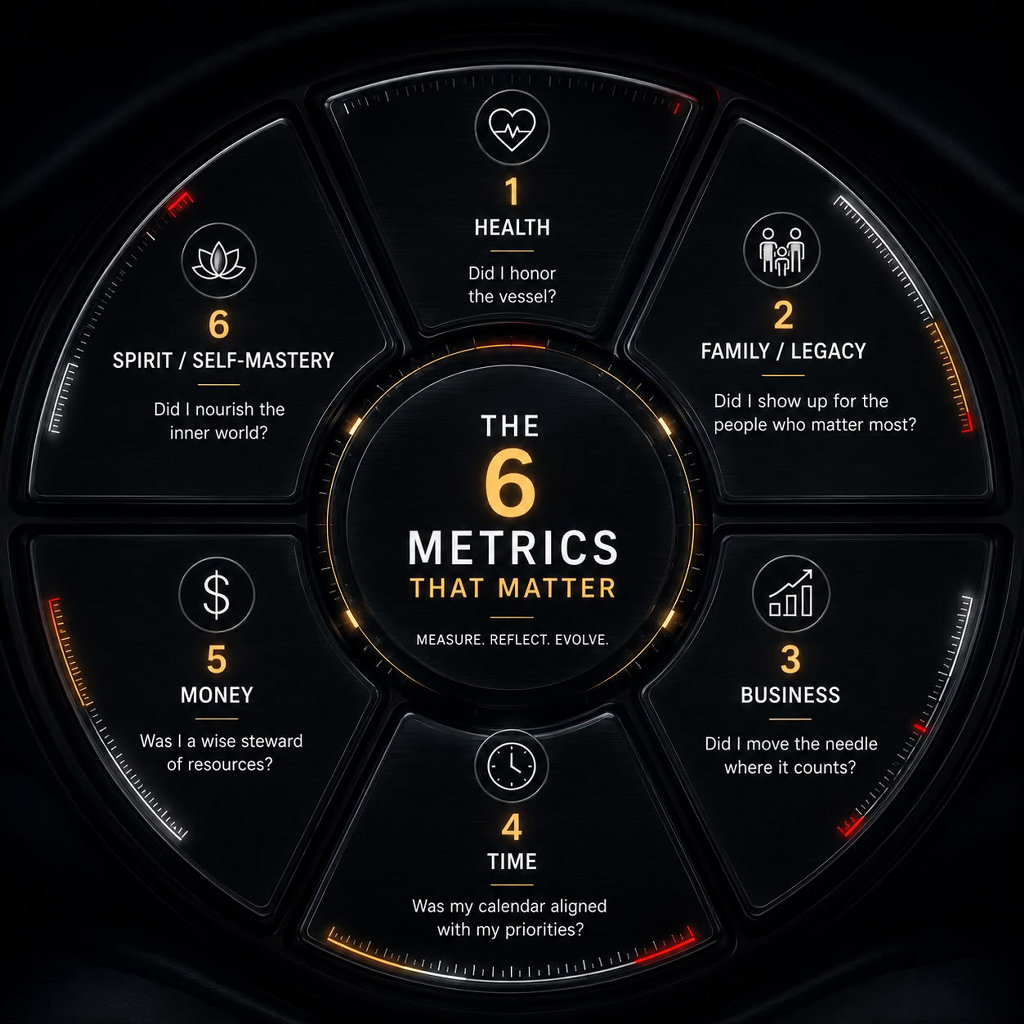
Every serious enterprise has a dashboard. Great companies measure what matters. Elite athletes measure what matters. Pilots measure what matters. Why should the most important enterprise any of us will ever lead be any different?
For me, it has become six questions.
Health. Did I honor the vessel that carries me through life?
Family and legacy. Did I strengthen the relationships that matter most?
Business and contribution. Did I create value that made someone else’s life better?
Time. Did my calendar reflect my values, or merely my obligations?
Financial stewardship. Did I allocate resources intentionally, in service of a long-term mission?
Spirit and self-mastery. Did I become a little wiser, more present, more grateful, more aligned with the person I intend to become?
These are not performance metrics. They are awareness metrics.
They remind me where I really am. They reveal when old patterns start to return. They remind me of the principles I have chosen. And they keep me building intentionally rather than drifting unconsciously.
That is the operating system.
Measure honestly. Reflect deeply. Act intentionally. Repeat consistently.
Because measurement creates awareness. Reflection creates wisdom. Intentional action creates transformation. And repeated consistently, transformation becomes identity.
Identity, over time, becomes destiny.
The Discipline of Renewal
We are entering one of the most significant periods of change in human history. Artificial intelligence, biotechnology, robotics, and longevity science are no longer advancing independently. Each breakthrough accelerates the next. The result is not simply faster change. It is phase change, where the rules themselves begin to evolve.
Careers will be reinvented. Industries will disappear and emerge. Many of our assumptions about work, learning, health, and aging will not survive the decade.
In a world like that, stability cannot come from preserving old patterns. It can only come from preserving timeless principles while continually redesigning the patterns through which those principles are expressed.
That is the discipline. And it is not a solitary one.
Every better leader creates better leaders. Every stronger family creates stronger families. Every healthier community creates healthier communities. We grow so that we can contribute. We contribute so that others may grow. The purpose is never simply our own transformation. It is creating the conditions where transformation becomes possible for others.
Schumpeter showed us how economies renew themselves.
My hope is that this essay has suggested people can do the same. Not by abandoning who they are, but by continually refining who they are becoming.
Get clear on where you really are. Preserve the principles. Destroy the old patterns. Build the future.
Because a meaningful life is not something we find.
It is something we build. One intentional decision at a time.
R.G. Dobson is the Chairman of CMG.ASIA, with a 25-year track record building category-defining wellness and lifestyle platforms across Asia and beyond.