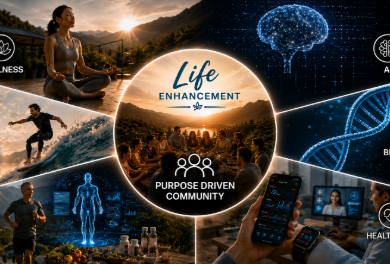

Fifteen years ago, I stood on stage in Lake Tahoe in front of more than 1,500 fitness business owners and operators, outlining where I believed the industry was heading. I called it Life Enhancement – something that went well beyond the fitness and wellness platforms available at the time. The idea was straightforward: move beyond gyms and wellness centers into a connected system. One that could monitor performance around the clock, combine wearable data, early-stage machine learning, and personalized coaching, and bring it all together in a single platform.
The response was immediate. At the end of the presentation, operators flooded to the back of the room to pre-enroll. The demand was real; the technology wasn’t ready. We ran the beta in my fitness centers as we scaled into Vietnam’s largest gym operator, but it never lived up to the promise. We spun it off, and COVID eventually shut it down. The idea was right. We were just early.
The Gap Between Experience and Outcome
Around that same time, I was building one of the leading Japanese beauty and longevity clinic businesses in Vietnam. That is where things came into sharper focus. The science was moving faster than most operators realized, so I started connecting the pieces: fitness as preventive care; clinics as corrective care. On paper, it worked. In practice, it exposed a gap I had not fully anticipated. Without real-time monitoring and diagnostics, what we had was not a system—it was still a collection of services. We could personalize the experience, but we couldn’t yet personalize the outcome. DNA testing was out of reach for most consumers, and early detection lived in the lab—slow, expensive, and disconnected from daily life.
We scaled anyway, despite the limitations. We grew from one clinic to nine in just a few years, integrated into a broader fitness and lifestyle ecosystem. By 2019, it had become Vietnam’s largest integrated health and wellness platform, spanning fitness, clinics, media, and community. We exited to private equity at a valuation of over 200 million dollars. In Vietnam, at that time, that was almost unheard of. The platform worked, the system scaled, and the market validated it. But in reality, we also benefited from pre-COVID capital markets that rewarded growth over sustainability.
The Evolution of Access
In 2016, I opened a business accelerator lab. The first company we helped launch was Hello Health Group, built by a sharp young founding team. I served as Chairman and led the investment rounds. The thesis was clear: digital health would scale access. And it did—nine countries and 35 million unique users.
But access alone is not enough. Information becomes commoditized. Without systems that drive outcomes, platforms do not hold lasting value. We were effectively building the WebMD of Southeast Asia. The model was clear: aggregate trusted health information and monetize attention. But that model has a shelf life. When information becomes instantly accessible, it stops being valuable on its own. Distribution shifts, behavior shifts, and the economics follow. I saw that shift early and exited once we brought in industry investors.
The Pattern of the Boom
These experiences—the early exits, the failed betas, the platform that worked and the one that did not—shaped how I see the industry today. Because what is happening now is not new. It is the continuation of a pattern I have watched play out across three decades and multiple markets.
The wellness industry is booming. More capital, more brands, and more demand than ever. But I have seen this before, and I know what it hides. In the early 2000s, capital flowed into scale: big box gyms, yoga studios, spas, and beauty clinics. The model was simple: build locations, sell access, and grow the footprint. For a period of time, it worked.
Today, capital is flowing somewhere else—into data, personalization, and platforms that can measure, predict, and influence outcomes. The difference today is not demand; it is how that demand is expressing itself. Capital is no longer flowing into centralized models alone. It is fragmenting into boutique gyms, recovery studios, longevity clinics, wellness retreats, and endurance events. What was once built through scale is now being rebuilt through specialization. The surface looks different, but the underlying pattern is the same.
Why They Still Fail
Growth does not mean health. When demand is strong, weak models survive longer than they should. Studios fill up, products sell, and expansion looks like success until it does not. Most businesses do not fail suddenly; they drift, quietly at first, toward imminent collapse under an unsustainable system.
They fail because they refuse to evolve. They rely on the same prepaid gym models, the same clinics selling promises without science, and the same playbooks written for a different era being run in a fundamentally different world. Consumers are more informed, expectations are higher, and technology has reset the standard.
Many of today’s entrants are not coming from within the industry. They are coming from disruption—technology professionals, corporate operators, and people searching for a more flexible or meaningful path. They see wellness as an opportunity, but they underestimate execution. Building a wellness business is not getting easier; it is getting more complex, more fragmented, and more demanding. With higher expectations and lower margins, there is less room for error. The real risk is not failure—it is holding on to outdated models too long.
The Convergence
COVID reshaped behavior, and AI accelerated everything around it. From wearables to biotechnology, we now have real-time visibility into how our bodies perform and the ability to meaningfully influence those outcomes. For the first time, the infrastructure has caught up with the idea I described on that stage in Lake Tahoe.
We are moving from wellness to life enhancement: from reactive to preventive, from generic to personalized, and from periodic to continuous. Fitness, medicine, AI, and data are no longer separate disciplines. They are converging into a single system—one where genetics set the baseline and intelligent systems determine the outcome. We do not control the DNA we are born with, but we increasingly control the environments and interventions that shape how it expresses.
The Next Generation
This is where most operators miss the moment. They see technology as a feature to market rather than infrastructure to build around. They add an app, integrate a wearable, rebrand around longevity, and call it transformation. It is not. Technology does not fix a weak model; it exposes one. Because in this category more than any other: Operations are the brand.
The next generation of companies will not be built on access or aesthetics. They will be built on three things:
- Systems that deliver results: Not activity or engagement metrics, but outcomes that people can feel, measure, and attribute to you.
- Intelligence that personalizes at scale: AI that augments human judgment rather than replacing it, making every interaction smarter than the last.
- Community that creates identity: People do not stay for access. They stay for who they become, and for who they become alongside others.
I have watched this cycle play out before. Different tools, different markets, but the same pattern: early excitement, over-expansion, and then consolidation. The winners are always the operators who actually deliver. The opportunity in wellness is real, but so is the failure rate. The question is not whether the industry will grow—it will. The question is whether you are building a wellness business, or a life enhancement system that truly makes life better