
After my first visit to Vietnam in 2005 to validate the market research I had done, I came up with a thesis that almost no one agreed with.
I believed Vietnam was going to become one of the most important wellness lifestyle markets in Southeast Asia.
When I told people I planned to build modern fitness centers there, the responses were predictable, bordering on prejudice. “Why Vietnam? Aren’t they still having a war? Why would people in Vietnam go to gyms, everyone’s already skinny.” We invested over $4 million on the first location. It was a big bet on what was still a non-existent market.
The stigma of history was still overpowering the reality of what was actually happening on the ground. The data told another story. A large, highly literate population. One of the youngest median ages in the region. A stable government overseeing a post-war economic transformation. And in 2007, entry into the WTO, which made FDI significantly easier and signaled to global capital that Vietnam was open for business.
From the moment I arrived, something felt unmistakably different in Vietnam compared to the five other Asian markets I had already operated in.
Every morning, the parks were alive. Not just elderly citizens practicing tai chi. Entire multi-generational families moving together. Kids, parents, grandparents. The desire for health, community, and vitality already existed. The infrastructure did not. That gave me and my partners the strong conviction we needed to place our bet. It was not easy. There were certainly years of muddy waters following the 2008 financial crisis and more than a few times staring into the abyss.
Vietnam wasn’t behind. It was at an inflection point.
That distinction changed the trajectory of my career. After more than a decade building in the fitness industry across North America and Asia under the mentorship of Mark Mastrov, often regarded as the godfather of the modern fitness industry, with successes like 24 Hour Fitness, UFC Gyms, Crunch, and YogaWorks, I had internalized one lesson above all others:
The greatest opportunities don’t emerge from crowded markets. They emerge from overlooked markets that are at inflection points which others dismiss.
In earlier writing I’ve explored how to navigate when the path isn’t clear, and how to read the lifecycle stage of a business. But there’s a prior question: how do you know if you’re building in the right direction at all? That’s what category design is actually about.
Category creators don’t just survive inflection points. They are the ones who saw the phase change coming and built solutions for problems no one had named yet.
Why Inflection Points Belong to Category Creators
Most people wait until the future is obvious.
Category creators feel the shift while it still looks irrational.
This is not instinct. It is pattern recognition, trained across enough cycles of disruption to read stress signals before they have language. Societies don’t change gradually and then announce it. They build pressure invisibly for years, and then the changes suddenly surface all at once.
The neuroscience is clear on this. Our brains evolved for threat detection and certainty-seeking, not opportunity recognition. We are wired to give more weight to the known than over the possible, to read ambiguity as danger rather than signal. This is why the biggest societal shifts almost always appear absurd before they become inevitable.
Wellness existed before the wellness industry existed. Esports existed before brands understood gaming culture. The creator economy existed years before analysts built decks explaining it. The signals are always there, carried first as tension, not data.
Society feels the shift long before it finds the words. The best builders learn to read that tension early
What Categories Actually Are
There is a critical misunderstanding in how most entrepreneurs think about category design.
They assume a category is just a market, a definable set of customers with a specific purchasing behavior. It isn’t. A category is a completely different point of view: a belief that a new problem exists and requires an entirely new kind of solution. Categories are philosophical before they are financial.
Apple was never really selling computers. It was selling the idea that creativity was a form of power, and that the right tools could liberate it. Netflix was never about DVDs. It was selling freedom from the tyranny of schedules. NVIDIA is no longer simply building chips. It is building the infrastructure layer beneath artificial intelligence itself.
The category creator doesn’t just serve a market. It reframes the problem that the market exists to solve.
This is why early-stage category companies look strange, niche, or premature. They are speaking a language the market hasn’t learned yet. The gap between the builder’s conviction and the market’s comprehension is not a weakness. It’s the moat. By the time consulting firms publish trend reports, the category creator is usually three years deep.
Why Community Comes Before Scale
Most founders start by thinking about scale.
The great category creators start with tribe.
Not audience. Not users. Community. A group of people organized around a shared identity and a problem the world hasn’t fully named yet.
CrossFit was never really about fitness. It was about belonging to something demanding enough to mean something. Harley-Davidson was never selling motorcycles. It was selling an identity: freedom, rebellion, brotherhood. The motorcycle was merely the vehicle. The early UFC built a tribe of true believers long before mainstream corporate sponsors understood the sport. The early Apple community believed, sincerely, that they were fighting conformity itself.
People don’t join category-defining movements because of features. They join because the movement reflects who they are becoming.
There is a Zen proverb I return to often: “Create a community and contribute to it.” In an era obsessed with virality, optimization, and growth hacking, that sounds almost embarrassingly simple. But I’ve come to believe it is more important now than it has ever been.
The human need for community doesn’t diminish as technology scales. It intensifies. The more automated our environment becomes, the more we crave experiences that feel irreducibly human.
That may turn out to be one of the defining economic truths of the next twenty years.
The Pattern I Keep Seeing
When I look back across my career, from scaling fitness centers all across Asia to building Vietnam’s largest wellness platform of fitness centers, clinics, and media, then exiting in 2019 at a $200M+ deal value to one of the largest fitness PE groups in the world, to the work we’re doing now with businesses that have social impact for Asia’s next rising billion across health tech, lifestyle, entertainment, hospitality, longevity, and beauty, the biggest wins have never come from following trends. They have come from redefining categories that make a meaningful impact to a small passionate group that turns into a movement.
Vietnam before global capital noticed. Wellness before it became mainstream. Esports before brands understood gaming culture.
The pattern is consistent: feel the tension early, contribute before you monetize, build community before you build scale, and endure the ambiguity long enough to reach the phase change on the other side.
This does not require predicting the future with precision. It requires recognizing direction, and having the conviction and capital to move toward it before the market validates the bet.
That conviction is uncomfortable. The muddy middle between a thesis and a market will test every dimension of a founder’s psychology. But the founders who shape categories are those willing to sit with the discomfort of being early long enough to be right.
That is what separates a category creator from everyone else. Not superior intelligence or perfect timing, but the resolve to build a solution for a problem the market hasn’t found the words for yet.
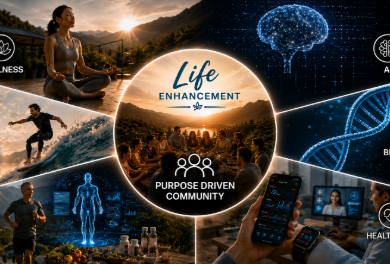
In the next article in this series, I’ll explore where I believe the next great category is forming, at the convergence of AI, longevity science, and what we call Life Enhancement.
R.G. Dobson is the Chairman of CMG.Asia, with a 30-year track record building category-defining wellness and lifestyle platforms across Southeast Asia and beyond.